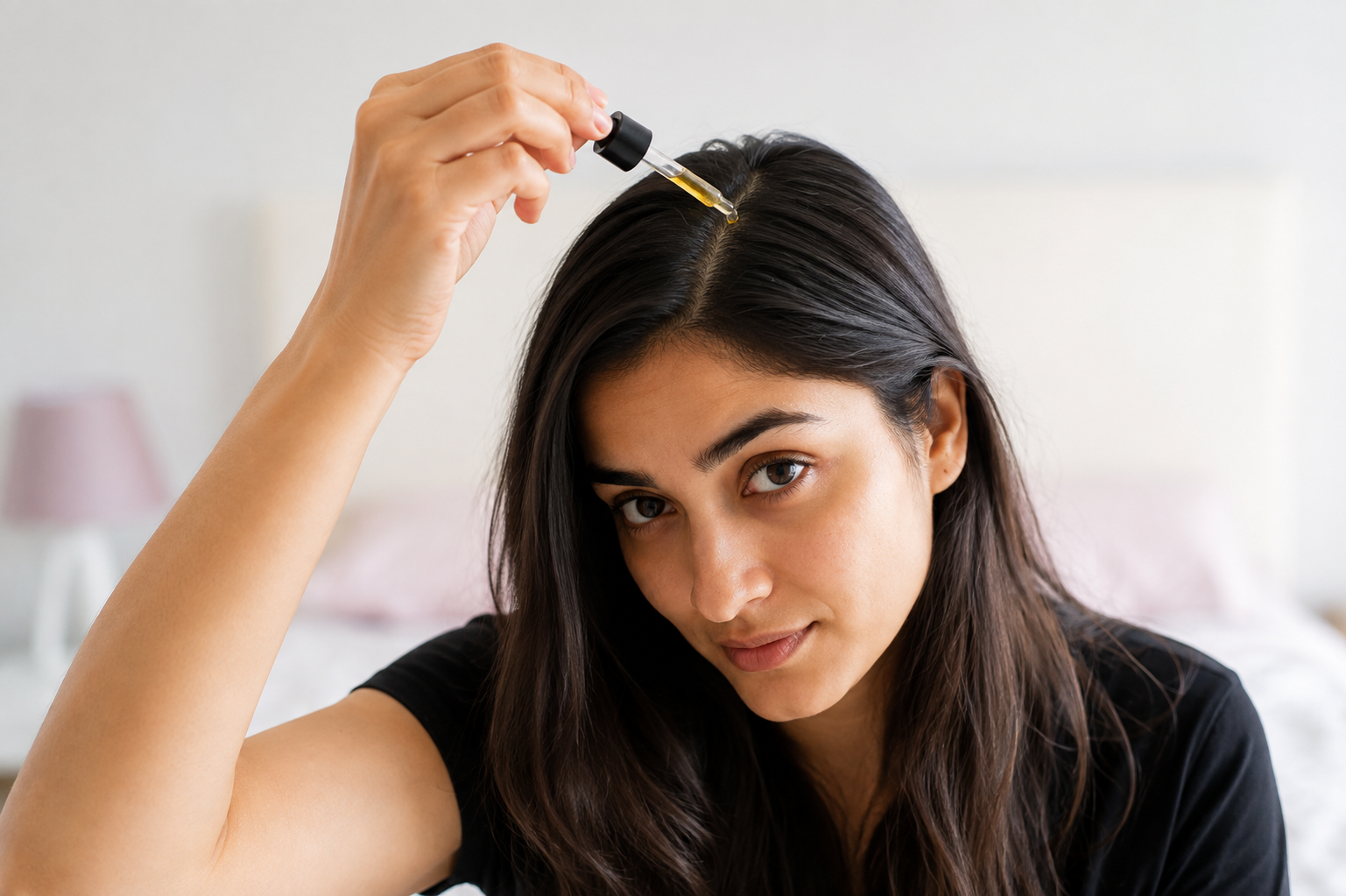


The short answer: Stopping a hair growth serum usually means you lose the benefit it was providing, not that you trigger new, worse shedding. Your hair fall may look similar to how it was before you started, since actives like Redensyl work only while used (StatPearls, 2023). This is different from minoxidil, an FDA-regulated drug where the AAD confirms discontinuation causes noticeably increased shedding within weeks (AAD).
Key takeaways:
- Cosmetic hair serums (Redensyl, Anagain, rosemary, caffeine) generally support the existing hair cycle rather than override it, so stopping tends to mean losing gained benefit, not a new shedding event.
- Minoxidil is a topical drug, and the AAD is explicit that stopping it causes hair to thin and shed more because the medication was actively maintaining hair thickness (AAD).
- About 10-15% of scalp hair is normally in the resting (telogen) phase at any time, and it sheds on its own schedule regardless of any product (StatPearls, Physiology of Hair).
- Telogen effluvium, the medical term for diffuse shedding after a stressor, resolves once the trigger is removed, and stopping a serum by itself is not a documented trigger (StatPearls, Telogen Effluvium).
- The fear of "serum dependency" often comes from noticing shedding return to a baseline that was there all along, once the product's temporary support is gone.
If you've been using a hair growth serum for a few months and you're thinking about stopping, there's a real question behind the worry: does hair fall come back, or does it come back worse? People on r/IndianBeautyTalks and r/indianbeautyyappers have described exactly this, repurchasing a rosemary rinse or a serum because shedding seemed to pick up the moment they paused it. That pattern is common, but it doesn't automatically mean the product created a dependency.
Will hair fall come back if you stop using a hair growth serum?
For most cosmetic hair growth serums, what comes back is your starting point, not a worse one. Ingredients like Redensyl and Anagain are formulated to support hair follicles while they're being used consistently, largely by encouraging follicles to stay in or re-enter the active growth (anagen) phase for longer (StatPearls, Physiology of Hair). Once you stop, that support stops too, and hairs resume their normal cycling pace. That can look and feel like shedding "returning," even though nothing has been damaged.
This is genuinely confusing in practice, because the timing lines up. You stop the serum, and a few weeks later you notice more strands in the shower drain. It's tempting to read that as cause and effect, and sometimes it is partly that, you're simply no longer getting the boost. But it's rarely evidence that the serum "held back" a bigger shedding event that was waiting to happen.
What's actually happening in your hair growth cycle?
Scalp hair moves through three phases: anagen (active growth, lasting years), a short transition phase called catagen, and telogen, the resting phase. At any given time, roughly 10-15% of your hair is in telogen and due to shed on its own timeline (StatPearls, Physiology of Hair). Losing 50-100 hairs a day from this normal turnover is expected, not a sign that anything has gone wrong (DermNet, Hair Shedding).
A serum doesn't pause this cycle indefinitely, it nudges the balance while it's in use. When you stop, hairs that would have entered telogen anyway do so, sometimes in a small cluster rather than spread evenly, which is what can make shedding feel sudden even though the underlying rate hasn't spiked.
Why does a serum feel like it "stopped working" the moment you quit?
Partly it's the cycle catching up, and partly it's attention. Once you're actively managing shedding, checking the drain, counting strands, you notice change more. If your serum was genuinely helping reduce hair fall, as Pilgrim's own consumer studies on its 3% Redensyl & 4% Anagain Advanced Hair Growth Serum have reported (brand-reported, from Pilgrim's own consumer panel, not an independent clinical trial), then stopping means losing that reduction, and your baseline shedding becomes visible again.
There's also a starting-phase version of this same confusion. Some people notice increased shedding in the first few weeks of using a new serum, not just after stopping one, a synchronized release of resting hairs that's a known, temporary pattern with minoxidil and is sometimes reported anecdotally with other scalp actives too (StatPearls, Telogen Effluvium). It resolves as the cycle re-settles, whether you're starting or stopping.
How do you tell rebound shedding from just losing the benefit?
Rebound shedding, a spike measurably worse than your pre-serum baseline, would be unusual for a cosmetic product and, if it happened consistently, would point to something else going on: a scalp condition, a nutritional gap, thyroid changes, or stress-related telogen effluvium, all recognized causes of diffuse shedding (StatPearls, Telogen Effluvium). Losing the benefit looks different: shedding drifts back toward where it was before you started, over a few weeks, and then stabilizes.
If your hair fall keeps climbing past your original baseline for more than a couple of months after stopping, or comes with visible thinning, patchy loss, or scalp changes, that's a reasonable point to see a dermatologist rather than assume it's the serum.
What should you do if you want to stop your hair growth serum?
You don't have to choose between using a serum forever and going back to square one overnight. Tapering, using it every other day for a few weeks instead of stopping abruptly, is a reasonable middle ground, and it makes it easier to tell whether any change you notice is the cycle settling or something new. If your goal was addressing everyday hair fall rather than treating a specific diagnosed condition, a gentler daily rinse such as Spanish Rosemary Water with Biotin can be a lower-commitment way to keep supporting your scalp without the same routine intensity.
Whatever you decide, give it time before judging the result. Hair cycle changes play out over weeks, not days, so a single bad wash day right after stopping isn't enough data to conclude anything.
Frequently asked questions
Does hair fall get worse than before if you stop a hair growth serum?
For most cosmetic hair growth serums, shedding tends to return to roughly your pre-serum baseline rather than get worse than it originally was. A true worsening beyond baseline is not well documented for cosmetic actives and is more associated with drug treatments like minoxidil.
How long after stopping a hair growth serum does shedding come back?
Because scalp hair sheds on a cycle rather than instantly, changes usually become noticeable within a few weeks of stopping a serum, as hairs that were being supported move back into their normal resting pattern. It typically levels off within one to two months.
Is stopping minoxidil the same as stopping a cosmetic hair serum?
No. Minoxidil is an FDA-regulated drug, and the American Academy of Dermatology confirms that stopping it causes hair to thin and shed more because the drug was actively maintaining hair thickness. Cosmetic serums with ingredients like Redensyl or rosemary extract don't carry the same documented discontinuation effect.
Can you become dependent on a hair growth serum?
"Dependency" isn't the accurate term for what's happening with a cosmetic serum, you're not developing a physiological need for it, you're simply losing a benefit you'd grown used to once you stop using it. The sensation of dependency comes from the timing lining up with your normal hair cycle catching up.
Should you taper off a hair growth serum instead of stopping suddenly?
Tapering, such as reducing to every other day for a few weeks, is a reasonable way to transition off a serum and makes it easier to judge whether any shedding you notice is your hair cycle settling rather than a new problem. It isn't medically required, just a gentler way to observe the change.
When should hair fall after stopping a serum see a dermatologist?
If shedding keeps increasing for more than about two months after stopping, or you notice thinning patches, scalp redness, or hair breaking near the root rather than falling from the root, it's worth seeing a dermatologist to rule out telogen effluvium, thyroid changes, or another underlying cause.
Do hair growth serums work differently from hair oils for hair fall?
Yes, most hair growth serums are formulated with concentrated actives (like Redensyl or Anagain) meant to support the scalp and follicle environment, while hair oils and rinses tend to focus on strand strength, breakage, and scalp nourishment. Both can play a role, but they're addressing slightly different parts of the hair fall picture.
References
StatPearls. "Telogen Effluvium." NCBI Bookshelf, 2023. https://www.ncbi.nlm.nih.gov/books/NBK430848/
StatPearls. "Physiology, Hair." NCBI Bookshelf, 2023. https://www.ncbi.nlm.nih.gov/books/NBK499948/
DermNet NZ. "Hair Shedding." https://dermnetnz.org/topics/hair-shedding
American Academy of Dermatology Association. "What Is Male Pattern Hair Loss, and Can It Be Treated?" https://www.aad.org/public/diseases/hair-loss/treatment/male-pattern-hair-loss-treatment